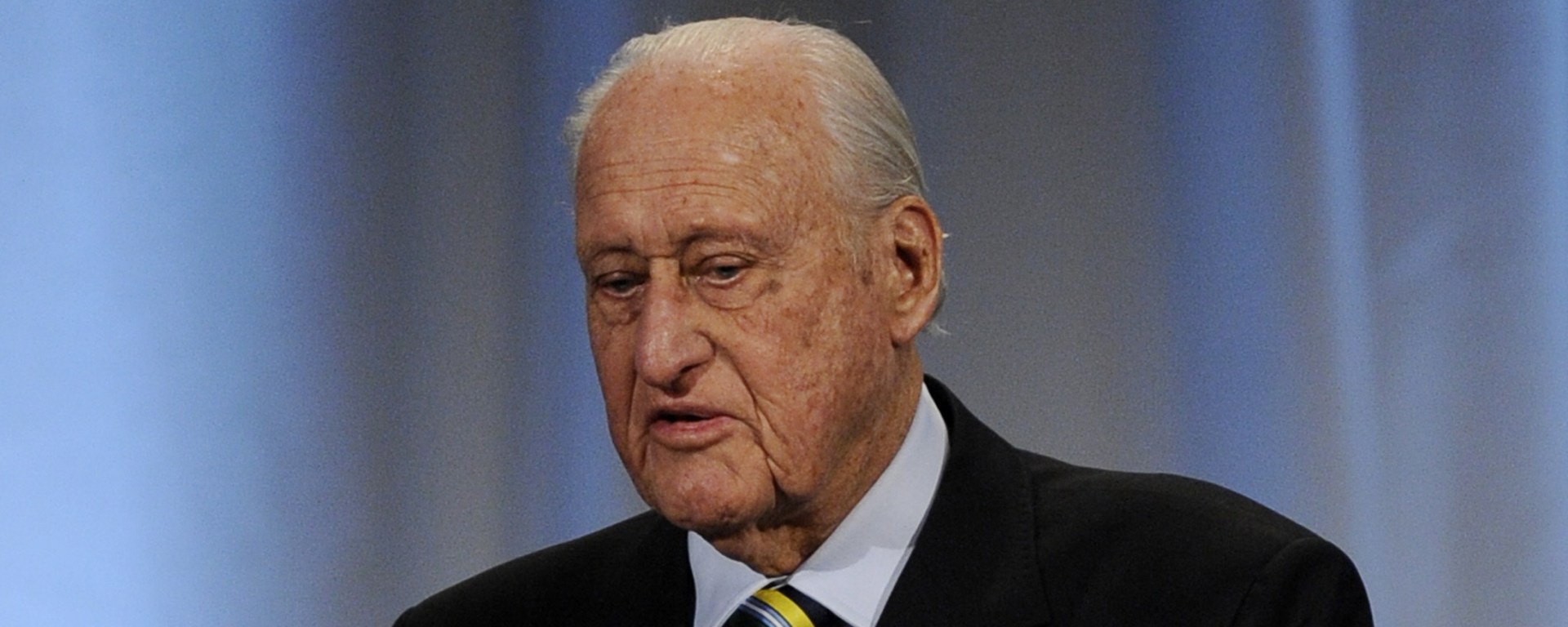
The late FIFA president understood post-colonial football in a way that the English are still unable to do.
Don’t tell Brazilians, but their Olympic stadium is still technically named after controversial former FIFA president Joao Havelange, who passed away yesterday at the age of 100.
Havelange, a former Olympic swimmer, was accused of taking millions of dollars in bribes from Swiss agency ICL in 2010 to maintain it’s position as FIFA sole marketer, and the allegations ultimately forced him to resign as FIFA’s honorary president in 2013.
Therefore it’s not surprising that some were very clear about what Havelange’s legacy is.
However, no matter how embarrassing it may be, the reality is that Havelange is the father of football as we know it.
When Havelange was elected FIFA President, he said: “I have come to change entirely the way Fifa works. I have come to sell a product called football.”
In that respect, his mission was an unqualified success.
Rewind to England’s World Cup win in 1966. When looking back at arguably the greatest sporting moment in our history, we tend not to remember some of the controversial refereeing decisions or the fact that of sixteen teams, only one entrant from Asia and Africa combined was allowed to compete. But the rest of the world remembers.
Pre-1974, FIFA under Sir Stanley Rous was tailored to the colonial world. Former schoolmaster and referee Rous was incorruptible, once saying in an interview: “In South America I was once asked by an ambitious football club official what it would cost to get on to the Fifa committee. I told him his £200 fare to Zurich and the support of at least 60 per cent of the delegates.”
But he failed to see how the world was changing around him. When the tide turned against Apartheid and the African Football Confederation (CAF) banned South Africa from the global game, Rous intervened personally to see the South Africans readmitted to FIFA, believing sport should not interfere in politics.
As more countries gained independence, so Havelange gained more supporters. These newly-independent countries, coupled with the South Americans who hadn’t forgotten 1966, propelled him to victory in 1974.
The World Cup we know today, a truly global event where nine of 32 teams are from Asia and Africa, is all down to Havelange’s legacy. It is absolutely possible that without Havelange’s victory in 1974, football would have had the profile of rugby or cricket, and a sport like basketball could have become the global sport, marketable to every country on the planet.
Even international youth football didn’t exist before Havelange.
If you couldn’t understand how Sepp Blatter had such firm support within FIFA for so long, it is because Joao Havelange was his mentor. Blatter’s World Cup in South Africa, the first in Africa, was the culmination of Havelange’s vision.
In 2011, when then-FA Chairman David Bernstein went to the FIFA Congress to call for a reform candidate to stand against Blatter, he was viciously attacked by association presidents from all over the world. But it wasn’t just the so-called ‘third world’, even the likes of Cyprus and Spain joined in.
If it wasn’t for Michel Platini stupidly humiliating the United States to give the World Cup to Qatar on Nicolas Sarkozy’s say-so, thereby providing the FBI with an incentive to get involved, then the FA would have been completely isolated and Blatter’s reign could have continued for decades.
Why? Because these presidents remembered the Rous FIFA and preferred the Blatter version, for all its faults.
While we believe, with our football tradition and infrastructure, that we are far more deserving of a World Cup than the next two hosts, Russia and Qatar, we forget how that comes across to the rest of the world. However they were awarded the competition, the fact that we live in a world where these countries CAN host the greatest sporting event on the planet is a message of hope from FIFA to all football associations.
In the post-Havelange FIFA, the tide of history is not on our side. The English bitterness about the decision not to award the country the 2018 World Cup looks to other associations like a pining for the days of Sir Stanley Rous.
And if you think that the end of Blatter will result in a renewed desire to hand international competitions to the likes of England, think again.
Here’s what new FIFA president Gianni Infantino had to say about Havelange: “During his 24 years as FIFA President, football became truly global, reaching new territories and bringing the game to all corners of the world — something the whole football community should be grateful for.”
Infantino himself is a man who supports more globalisation of football, not less. The 2020 European Championships, which will be held across Europe, were his brainchild, and he wants to do the same with World Cups.
If England wants to keep its place at the top table of world football, it needs to look like a country that has come to terms with the Joao Havelange revolution.
 Sam Street Sports