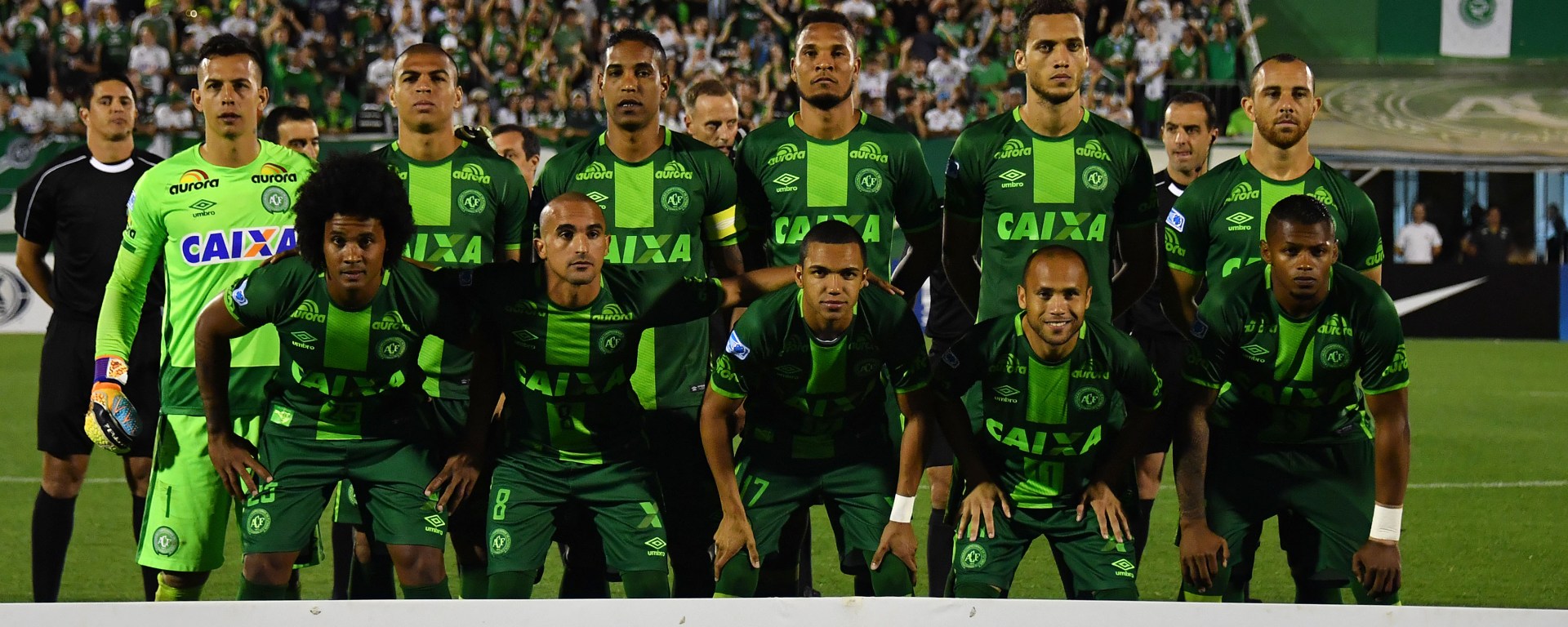
One of South American football’s greatest underdog tales has been left tragically unfinished.
Nobody needs to be told about the human consequences of the Chapecoense team’s tragic air crash in Colombia. The wives who have lost husbands, the children who have lost fathers and all those who have lost close friends in an accident that has left a community devastated.
At times like this, football can only take a back seat and it has to be remembered that the lives of the journalists and flight crew on board were not worth any less for the fact they weren’t part of Chapecoense’s success.
But here is the story of Associação Chapecoense de Futebol and why, in football terms as well as human terms, it really is a tragedy as great as Munich.
It all started in 2009 for what was then a non-league side from the small city of Chapecó, bordering Argentina.
Now non-league football in Brazil is not the same romantic experience as non-league football in England, because it simply doesn’t exist. Teams play a state championship for four months in front of crowds that often don’t even number in the hundreds, in order to earn the right to play more football.
If they place among the top teams in their state, they advance to Serie D and if they don’t, the players have to, almost literally, find some other way to survive for the remaining eight months of the year.
Then in Serie D, teams must win promotion to be guaranteed more than four months of football the following year. The league matches are played in front of sparse crowds, but knockout games can see whole towns come out in the hope of seeing their local team earn the right to, basically, exist for 12 months a year.
The Serie D playoff that started Chapecoense on their magical journey was, what we would call, a throwback.
Three years later I happened to have the opportunity to see them in person when I was living in the Northeast of Brazil. Second in the league, they had a total off-day, losing 2-0 at ABC of Natal, who played a 15 minute walk from my apartment. But it was nothing more than a blip as they comfortably won promotion to Serie A in second place.
Then came the challenge of staying in the top flight. Brazilian football is not English football and the powers that be see no appeal in stories like Leicester. Small clubs are an irrelevance that can sometimes end up relegated, not by their performance on the pitch but by the authorities simply making up rules on the spot to keep the biggest clubs in the league.
However Chapecoense managed to keep themselves out of trouble and earn a reputation as a David to the top sides’ Goliath. Even before their Copa Sudamericana run, fans across Brazil talked about them as giant slayers because their results against the biggest sides tended to be infinitely better than against the smaller ones.
As it happens, the team that I watched bore little resemblance to the one that was killed in the plane crash, with only two players still remaining at the club from that day three years ago.
But Chapecoense didn’t just go around replacing local talent with superstars. Of the new signings, 35-year-old former Atletico Madrid man Cleber Santana was the most well-known player and the only one who had achieved any kind of fame in Europe.
Just like the those who got the team promoted, the players who led Chapecoense to the Copa Sudamericana final were fighters, who had either made it through the Brazilian lower leagues or a Brazilian academy system as tough as the British one in the 60s. No mercenaries, just honest blokes who bought into the identity of a small town club.
The closeness of the players was summed up in this heartbreaking video which showed the squad inform team-mate Thiaguinho, just a week ago, that he was going to be a father.
In the South American version of the Europa League, they carried on doing what they had been doing in their home country – giant-killing. In the last 16, one of the biggest clubs in Argentina, Independiente, were beaten on penalties after two 0-0 draws. In the semi-final, Chapecoense overcame huge odds to beat San Lorenzo, the Buenos Aires side who were Copa Libertadores winners two years previously, on away goals.
Goalkeeper Danilo was the hero in both of those matches, saving four penalties against Independiente and keeping San Lorenzo from nicking it in the last minute of the semi-final.
“No hero nonsense for me,” he said after the match. “No one wins a war by himself. It would be unfair for my team if I had that goal go against me in the final minute of the match. Everyone’s happy. Once again, our team’s united effort proved itself to be responsible for our win.”
Danilo was rescued from the plane crash and made it to the hospital in Colombia. A lifelong Chapecoense fan, it would have been wonderfully symbolic if this warrior had survived, but unfortunately this was one battle he couldn’t win.
In life they captured the hearts and minds of fans in Brazil and in death they captured the hearts and minds of the world. Now they will surely do what seemed previously impossible for a small club and capture the hearts and minds of Brazil’s football authorities.
Their fellow clubs in Serie A have proposed to loan Chapecoense players for free next season and guarantee they will not be relegated for three years, while their Colombian opponents in the Copa Sudamericana final, Atletico Nacional, have offered them the trophy. To accept these offers as soon as possible, would be the minimum football can do.
 Sam Street Sports